Stop the
$2 Billion Dollar Super Gondola
The proposed gondola project in Little Cottonwood Canyon (LCC) is an outrageously expensive and unnecessary boondoggle that could cost Utah taxpayers up to $2 billion in lifetime costs – money that could be far better spent on practical, proven solutions like enhanced road maintenance and safety with dedicated canyon snowplows & additional winter buses.
This flawed project prioritizes a ugly, unproven, unnecessary monstrosity over effective alternatives that address traffic, safety, and environmental concerns.
Utah's stunning Little Cottonwood Canyon is under threat from an aerial ropeway proposal that's ballooned into a growing projected lifetime $2 billion taxpayer-funded disaster.
Originally pitched as a traffic solution for skiers, the flawed project's costs have skyrocketed due to consultants,
sub-consultants, inflation, tariffs, insurance, construction challenges, lawsuits & poor planning.
For a fraction of the ski gondola's price tag, we could expand bus services and deploy additional snowplows to keep canyon roads clear, safe, increase throughput, and ensure reliable access without scarring the landscape with massive towers, cables and flashing FAA lights.
WHY WE MUST STOP THIS WASTEFUL PROJECT
COMMON SENSE SOLUTIONS:
DEDICATED SNOWPLOWS & MORE BUSES


UDOT's snowplow operators are highly competent and capable professionals who work tirelessly to keep Utah's roads safe during winter storms. However, it appears systemic limitations and policies imposed by leadership—such as inadequate planning, funding and understaffing for snow removal—have created challenges that exacerbate congestion and safety risks in high-snow areas like Little Cottonwood Canyon (LCC).
This under-resourcing appears to align with a "bucket system" policy where plows are deployed based on priorities, often leaving secondary routes like SR-210 as an afterthought. While every road deserves priority for clearance to ensure public safety, the current approach prioritizes major highways, leading to reactive rather than proactive maintenance in the canyons where snowfall is heaviest—resulting in heavy accumulation, spinning vehicles, and reduced throughput.
In previous winters, the lack of dedicated road maintenance in Little Cottonwood Canyon has led to poor conditions, including snow-packed roads, reduced visibility, and hazardous driving—exacerbating congestion and safety risks on SR-210.
The closest UDOT snow plow is parked 15 miles away in the Salt Lake Valley. When a storm hits, UDOT plows are dispatched by “priority” — and Little Cottonwood Canyon is not at the top of the list. I-80, I-15, Parleys all get cleared first. By the time a snowplow is dispatched the mountain road is already buried and gridlocked. Hence the need for wheel chains.
UDOT is also responsible for plowing the Alta Bypass Road — the narrow, steep service route connecting Snowbird and Alta that bypasses avalanche-prone sections of Hellgate and Superior. The Bypass is chronically neglected too, often becoming a snow-packed nightmare causing gridlock with 23 merge points.
Solutions are within reach.
EXPOSING UDOT's CRISIS OF BIAS, WASTE & FLAWS
ADVOCATING REAL SOLUTIONS FOR ROAD SAFETY & CONGESTION
This isn't just any gondola — it's a SUPER-GONDOLA! 💸
The longest and highest-elevation aerial gondola ever proposed on planet Earth, facing unprecedented challenges
| Super Challenge | Super Details |
|---|---|
| 🔴 SUPER-LONG | The purpose of a ropeway is to go where roads cannot. The LCC gondola would span 8 miles and 30-40 minutes. North American winter gondola journeys average around 2.5 miles and 10 minutes. No other gondola has been built to run year-round over such a lengthy journey, crossing 30+ avalanche paths in a narrow canyon—for good common-sense reasons, including extreme weather exposure, maintenance and engineering challenges. It's not a practical, cost-effective transportation choice. |
| ⚠️ SUPER-INEFFICIENT | It's a high-risk engineering endeavor that would shut down in high winds, lightning, & avalanche danger—exactly when access and shelter is needed most. Cabins will NOT have heat or electricity, as that would require installing high-voltage power lines with the gondola-carrying and hauling cables, which is not feasible. Look no further for practicality than Snowbird's existing tram (costs $60), which spans only 1.6 miles and typically shuts down 20–30 times per winter due to similar conditions. |
| 💰 SUPER-EXPENSIVE | This is not a roadway project, but a ropeway overreach. Because of its extreme length and exposure, the projected lifetime costs are extraordinarily high: now estimated at $1.8–$2.1 billion (in 2025 dollars), making it one of the most expensive gondolas ever proposed. No private business would feasibly fund this scale of project without massive subsidies—why should taxpayers? |
| 🗑️ SUPER-WASTEFUL | Utah taxpayers are being asked to fund the longest, riskiest, and most expensive ropeway in history—for the primary benefit of two private ski resorts. Unless heavily subsidized, the LCC gondola ticket price is projected to be $75+ per person, adding further cost burden to users. The ski gondola represents wasteful government spending at its worst—benefiting two private resorts while burdening every Utah household with an estimated $1,000–$1,700 in costs. |
For 5% of this price we could buy additional ski buses + dedicated snowplows
and actually solve the problem and increase safety.
POOR FEASIBILITY AMID FREQUENT WIND CLOSURES
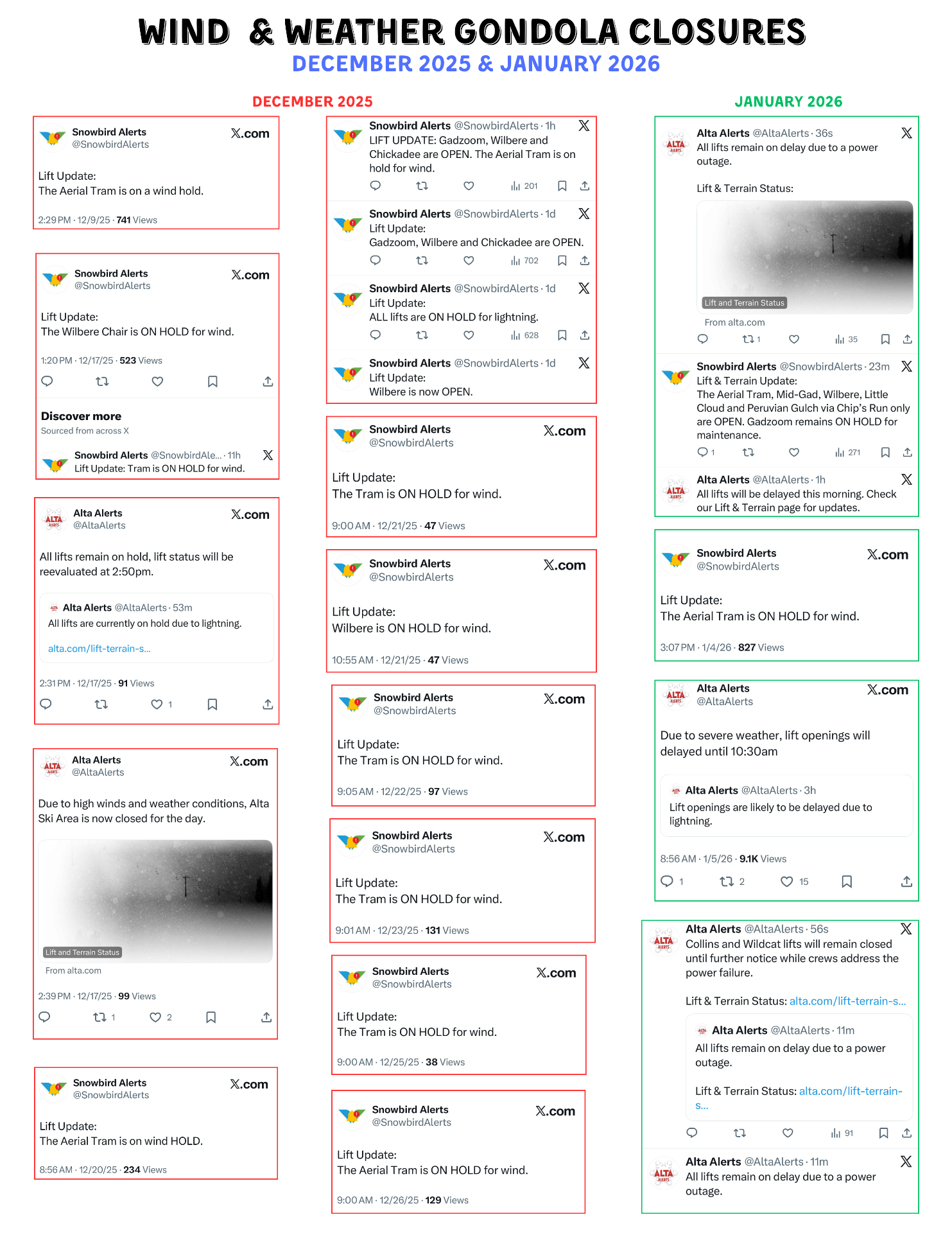
Frequent Wind Closures on Existing Aerial Systems
Documentation from @SnowbirdAlerts and @AltaAlerts on X reveals a consistent trend of wind-related closures affecting aerial lifts in the canyon aligned with the proposed gondola route. In December 2025, there were at least 10 instances of wind holds reported, impacting major lifts. These closures are commonplace during windy conditions, occurring frequently, sometimes on a daily basis, underscoring the canyon's known vulnerability to the high winds typical of the Wasatch Range.
Snowbird generally faces 20 to 30 wind-related safety closures each season.
The proposed LCC Gondola is scheduled to operate seasonally for 140 days with 22 staff members per shift.
However, historical weather data suggests the operational days may be reduced to 115 due to potential weather and wind-related safety closures.

| Mode | PPH | Visual |
|---|---|---|
| Private Vehicles (900 vph x 2.5 avg people) | 2250 | █████████████████████ |
| Current Buses (20 buses x 42 people) | 840 | ████████ |
| Additional Buses (70 buses x 42 people) | 2940 | ████████████████████████████ |
| Combined Current (Private Vehicles + Current Buses) | 3090 | █████████████████████████████ |
| Combined Enhanced (Private Vehicles + Additional Buses) | 5190 | ██████████████████████████████████████████████████ |
| Gondola (30 Cabins x 35 Max Capacity) | 1050 | █████████ |
| Gondola (25 Max Capacity w/ Ski Gear) | 750 | ███████ |
TRANSPORTATION COMPARISON CHART (Hourly Capacity)
PUBLIC MISINFORMATION, MISREPORTING & OMISSIONS
UDOT's extensive mountain of documentation from contractors & subcontractors
— has cost taxpayers $8.2 million dollars to date!
Yet fails to provide clear, basic facts on the gondola's functionality. Critical omissions include:
Limited Operational Capacity: The gondola is designed with cabins arriving every 2 minutes, each holding ~25 passengers with ski gear (35 max capacity w/o gear). This results in a realistic throughput far below exaggerated claims, with only 30 cabins in operation at peak. Basic math shows this system cannot efficiently handle high-demand scenarios, offering no meaningful public benefit for long-term planning.
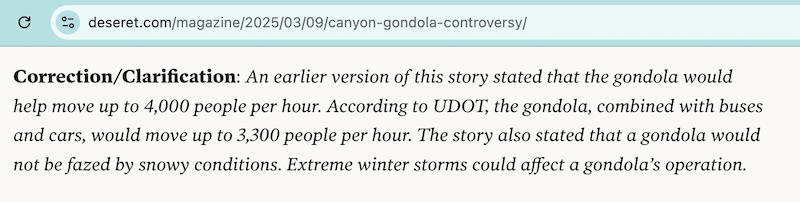
Inaccurate Media Reporting: Outlets like Deseret News have misreported the gondola's capacity as 4,000 people per hour (PPH), a grossly inflated figure that ignores the EIS documents' specifications. Such misinformation distorts public perception and undermines informed debate.
Weather and Safety Vulnerabilities: The gondola will not operate during extreme winter storms, high winds, inter-lodge restrictions, or when SR-210 is closed for avalanche mitigation. This renders it unreliable precisely when canyon access is most challenging, leaving skiers, residents, and visitors without viable alternatives.
These gaps highlight a lack of accountability in UDOT's process, where consultants and subcontractors produced voluminous reports without addressing fundamental realities.
Exposing Misleading Claims by Gondola Works:
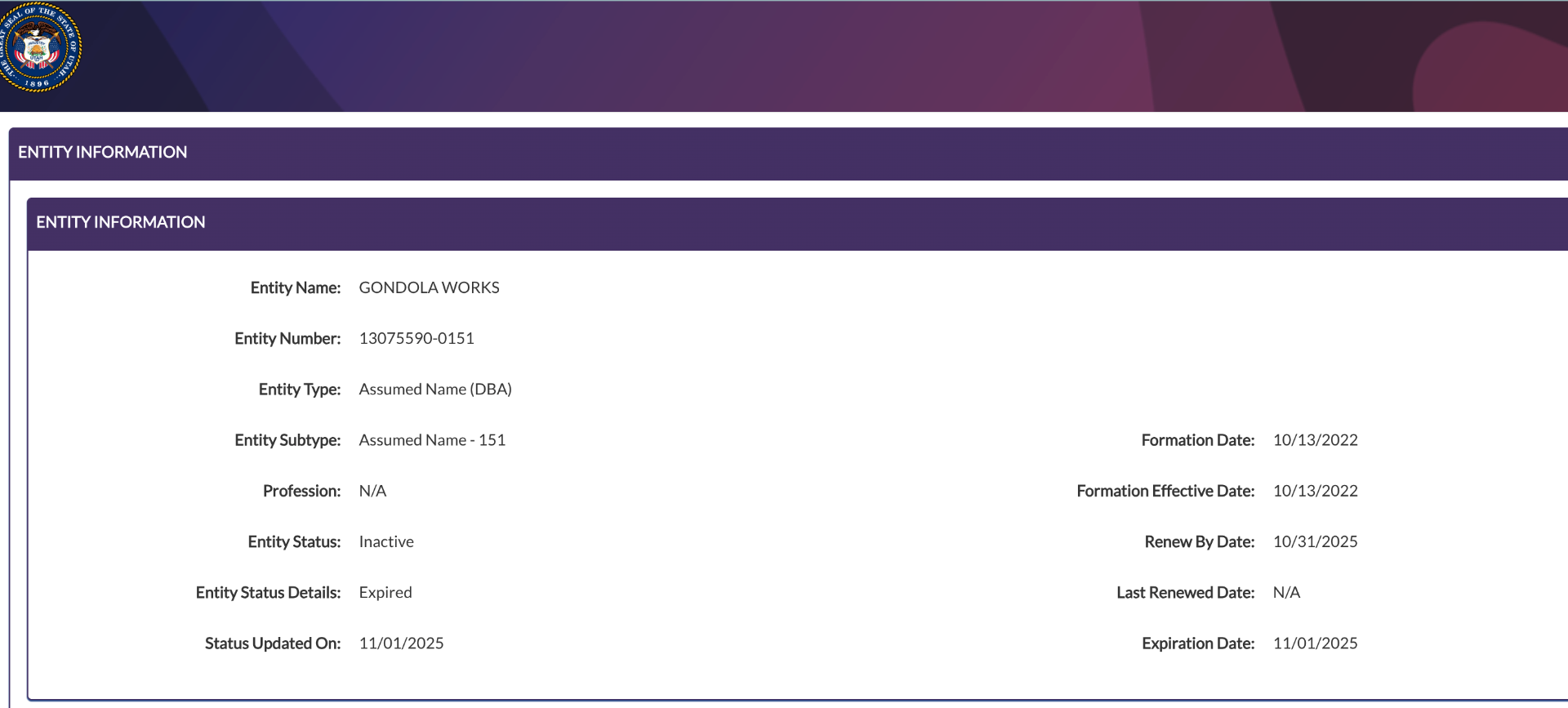
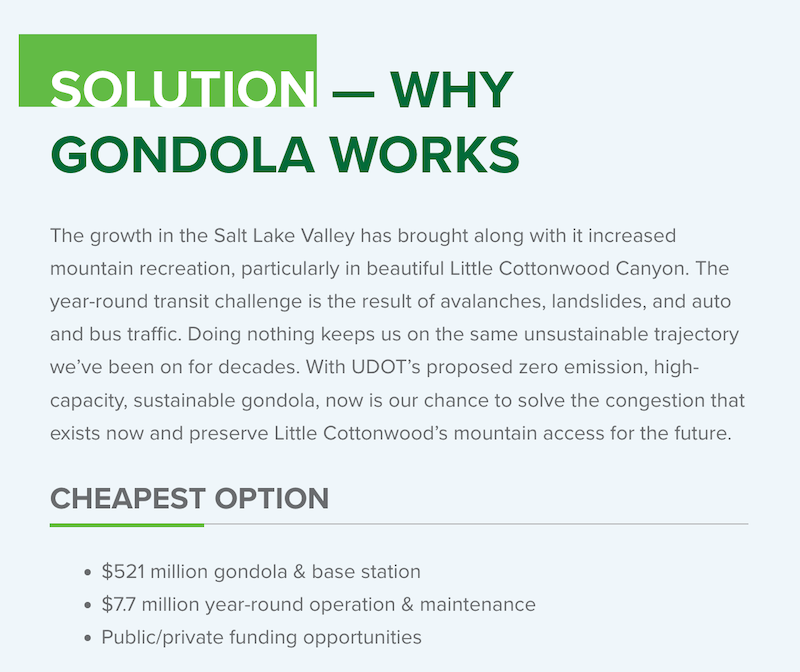
The defunct entity Gondola Works (GW) has aggressively promoted the project as the "CHEAPEST OPTION", disregarding UDOT's own 2022 cost escalation updates.
This company's inability to pay a mere $18 state renewal fee raises serious questions about its ethical practices & finances.
GW claims ignore escalating construction and maintenance costs, which far exceed alternatives like enhanced bus fleets and dedicated snowplows—solutions that could be implemented faster, at lower cost, and with broader benefits.
There is no public benefit or need to plan 15 years out for a system that will move FEW people, inefficiently in ONLY 30 cabins.
According to the UDOT EIS Annual O&M Cost: A gondola system would be a large investment, and UDOT or private operator would want to maximize its use and collect as much in fares as possible to pay for the gondola's capital investment and operation. The expensive system would also require employing 22 staff per shift.
AERIAL RIDE COST COMPARISON CHART
| Location | Distance | Time (Minutes) | Adult Roundtrip Ticket *Nov 2025* |
|---|---|---|---|
| Portland, OR | 0.6 mile | 4 | $18 |
| Sandia, NM | 2.6 miles | 15 | $34 |
| Palm Springs, CA | 2.5 miles | 10 | $37 |
| Heavenly, CA | 2.4 miles | 12 | $104 |
| Gold Belt, AK | 0.75 mile | 6 | $60 |
| Alyeska Resort, AK | 0.70 mile | 7 | $48 |
| Banff, Ca | 1.8 miles | 8 | $52 |
| Lake Louise, Ca | 1.4 miles | 14 | $45 |
| Jackson Hole, WY | 2.4 miles | 12 | $50 |
| Park City, Red Pine, UT | 1.25 miles | 8 | $73 |
| Snowbird, UT | 1.6 miles | 10 | $60 |
| LCC Gondola | 8.0 miles | 30-54+ park/shuttle | $75+ (Current LCC market price $60 + 25% UDOT overrun) |

UDOT's Tolling Scheme: Revenue Grab Masquerading as Congestion Fix
UDOT's LCC tolling proposal in the EIS reeks of a money-making scheme over genuine safety concerns, slapping a hefty $25 per car fee (ranging $20-$30, variable over time) on peak winter days to cut personal vehicles and push riders onto buses or the gondola.
This stands in stark contrast to UDOT's own low-key Adams Avenue Parkway toll, which costs just $1-$2 per car without fanfare, highlighting the inflated pricing in LCC that burdens families and low-income users (with token mitigations like off-peak access or subsidized buses).
UDOT doesn't even mention the words "Traction" or "Safety" in the tolling proposal.
Even more hypocritical, UDOT pledges to coordinate with the USDA Forest Service to minimize visual impacts from tolling tech like gantries or readers—avoiding ugly booths to prevent queues—while brazenly ignoring the gondola's 200+ foot towers and flashing FAA lights that would permanently scar the canyon's pristine aesthetics and wildlife habitats.
This cash-focused approach proves the gondola isn't about solutions or safety, but extraction; demand UDOT scrap it for affordable, non-intrusive fixes like expanded buses and QR-enforced traction laws instead.
LCC TOLLBOOTH PROPOSAL VEHICLE COSTS
REAL SOLUTIONS: Additional Buses + Dedicated Snowplows
For ONLY 5% of the gondola's cost
Additional Buses Provides 5,190 people per hour capacity
Dedicated Canyon Snowplows clears roads faster for better, safer throughput
— far more reliable, flexible and weather-proof than the proposed gondola
Immediate congestion relief • No canyon scarring • No $2B+ debt • No resort subsidy
Utahns Demand Buses & Snowplows Instead